
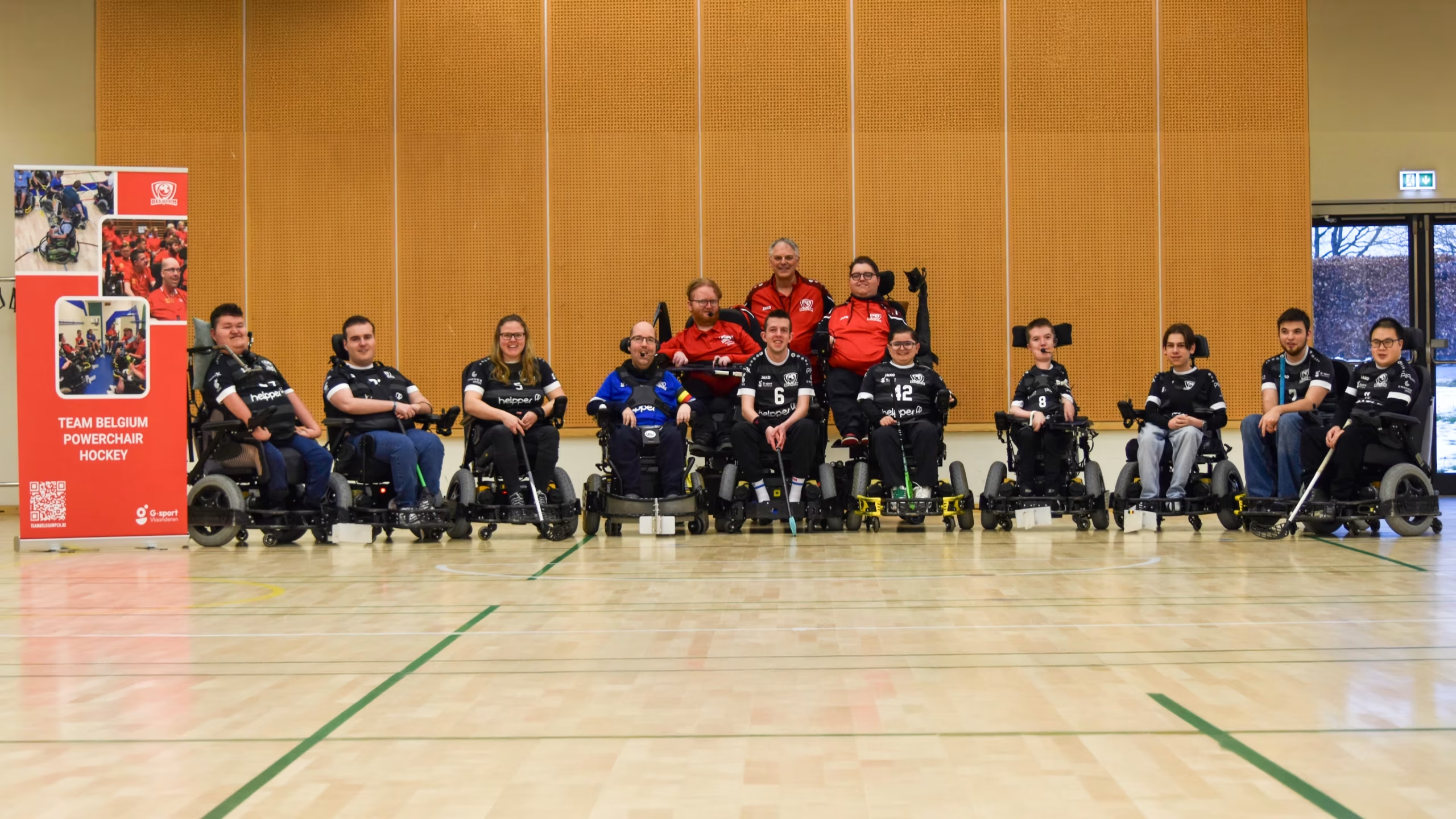
Belgium: A Nation Rebuilding for the World Championship 2026
As we approach the next World Championship, IPCH is launching a special collaboration to present all participating teams. For this project, we are proud to work with Paul Emmering, former German handstick player and scorer of Germany’s historic 2010 World Championship golden goal. With his long-standing experience in Powerchair Hockey, Paul will provide analyses, insights, and expert perspectives throughout our road to the World Championship. In this article, you can read more about Belgium’s insights.
A Compact Nation at the Heart of Europe
Situated between some of Europe’s major powers, Belgium may cover a relatively small area, but it has long carried influence far beyond its borders. Home to around 12 million people, Belgium is one of the most densely populated and urbanized countries in Europe, with a network of historic cities, modern industry and multilingual culture linking Dutch, French and German speaking communities.
The country is famous for far more than geography alone. Belgium is celebrated worldwide for its chocolate, pralines, waffles and fries. Its brewing tradition is among the most respected anywhere in the world.
That same central European position has helped Belgium remain closely connected to the development of Powerchair Hockey across the continent.
A Reliable Presence on the International Stage
Belgian club teams have regularly competed in European club tournaments, helping maintain a strong domestic connection to elite level play. The national team has also been a consistent participant at both European and World Championships.
At the 2024 European Championship in Denmark, Belgium qualified through the preliminary tournament before earning a respectable seventh place finish. That represented a modest but meaningful step forward from eighth place at the 2022 World Championship in Switzerland.
While Belgium is currently in transition, the country’s history in the sport includes periods when it stood among the very best.
The Generation That Built a Contender
Belgium’s early rise was driven by a gifted core of players who turned the nation into a genuine force.
The stick duo of Lars Reniers and Michael Przyklad gave the team a dynamic and entertaining attack during the World Championship in Helsinki in 2004 and European Championship in Rome in 2005
Alongside them, Kenny Verbraekel brought tireless work as a T stick player, strong blocking ability and an outstanding team first mentality. He also played an important role off the court in the organization of Belgian and international Powerchair Hockey. Then came the player who pushed Belgium within touching distance of titles.
Björn Sarrazyn became one of the defining stars of his generation. With 131 international goals, he held the all-time scoring record for many years before being overtaken only recently by Anders Berenth from Denmark. What made Belgium unique in that era was how completely the tactical system was designed around Sarrazyn’s strengths. The team maximized his finishing, movement and decision making with remarkable efficiency. It remains one of the clearest examples in international Powerchair Hockey of a nation building an elite structure around a world class scorer.
That formula delivered Belgium’s greatest results, reaching major finals against Netherlands at the 2012 European Championship in Finland and the 2014 World Championship in Germany.
A New Cycle Begins
For the upcoming World Championship, Belgium remains in the middle of a rebuilding phase. That process was initiated under former player legend An Vanheusden who remains the best female scorer of history with 62 goals. Now Belgium is being carried forward by Dutch coaching duo Bob Gotz and Ad Hagenaars.
Both bring deep experience from the Dutch system as players and coaches, offering fresh ideas from one of the sport’s most successful nations. Belgium’s current strength lies in a younger generation with significant upside.
Maxime Decrock reads the game impressively as a T-stick player and creates opportunities through smart positioning and effective blocks. Daan Van Nerum offers scoring touch and elegant ball control. With 40 international goals already, he continues to climb the scoring charts and still appears far from his ceiling.
Tactical Identity and a Tough Assignment
It remains to be seen exactly how Belgium will line up tactically under the new coaching staff. Their most successful historical model featured a central playmaker controlling possession before choosing the decisive pass or shot, and some variation of that approach may still be the most natural path in 2026.
Belgium’s group schedule in Finland is demanding. They face record World Champions Netherlands, fellow overseas contender Canada, improving side Australia, and finish against neighboring powerhouse Germany.
Outlook
Given the strength of Group B, Belgium’s primary objective will likely be to compete hard in every match, challenge more established contenders and continue their development against elite opposition.
A deep run may be difficult at this stage of the cycle, but the long-term picture is encouraging. With young talent, outside expertise and a proud history to draw from, Belgium looks like a nation capable of building something serious over the next few years.