
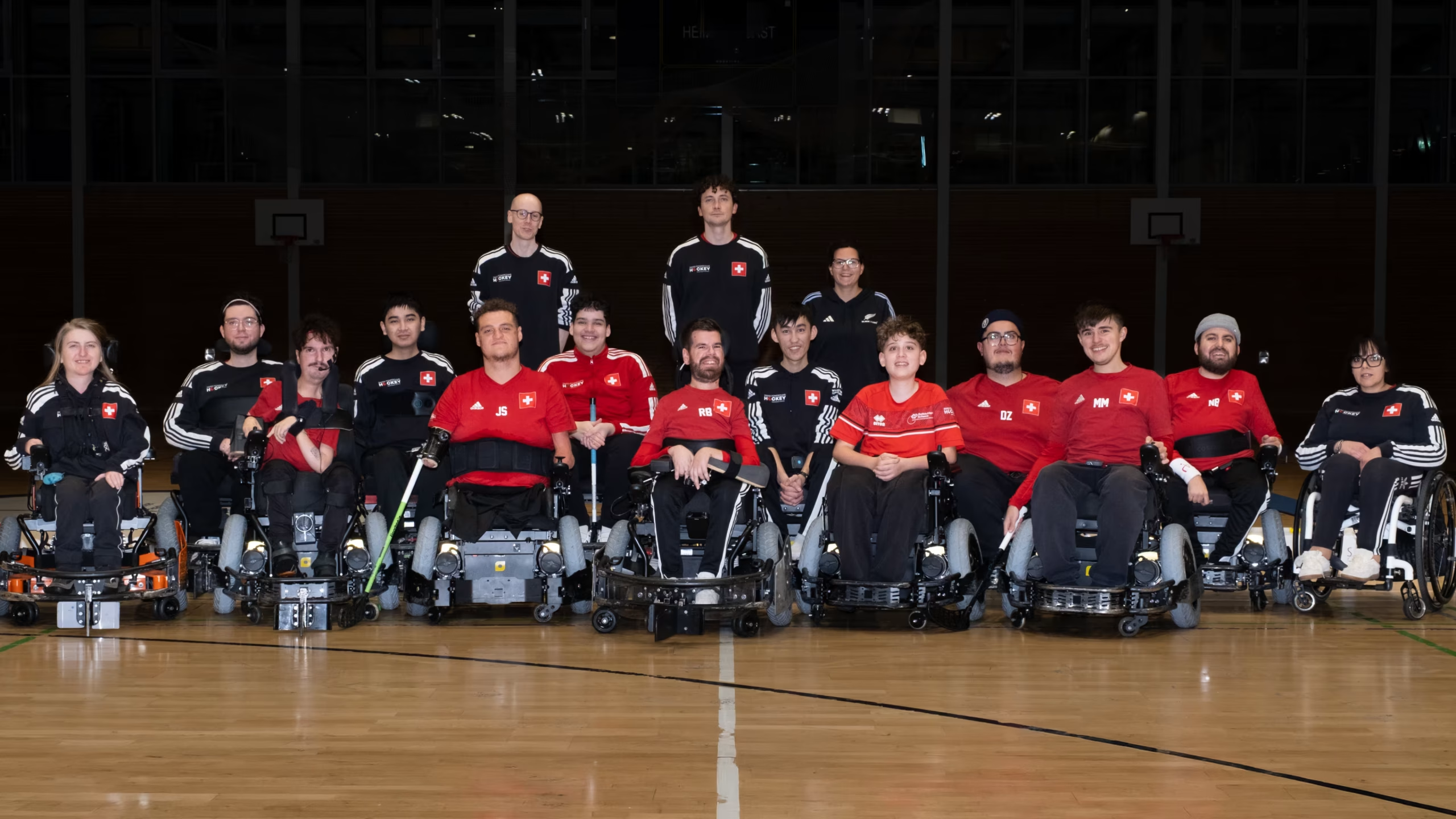
Switzerland: From Underdog to Contender at the World Championship 2026
As we approach the next World Championship, IPCH is launching a special collaboration to present all participating teams. For this project, we are proud to work with Paul Emmering, former German handstick player and scorer of Germany’s historic 2010 World Championship golden goal. With his long-standing experience in Powerchair Hockey, Paul will provide analyses, insights, and expert perspectives throughout our road to the World Championship. In this article, you can read more about Switzerland’s insights.
Tradition, Diversity and International Identity
With around 9 million inhabitants, Switzerland is one of the smaller nations both in Europe and at this World Championship. What the country may lack in size, however, it compensates for with tradition, stability and international influence.
Switzerland is widely regarded as one of the oldest and most stable democracies in the modern world, with a long-standing political system built around federalism and neutrality. The country is equally renowned for its exceptionally high quality of life, precision industries and culinary standards. Swiss cheese and chocolate have become global symbols of the country, while Swiss gastronomy overall is considered among the finest in Europe. One of Switzerland’s most fascinating characteristics is its cultural diversity. The country recognizes four official languages: German, French, Italian and Romansh. This multilingual identity has shaped a nation that combines different European influences within a remarkably compact geographical space.
Its regions and cities each offer their own unique atmosphere. Zurich stands as Switzerland’s vibrant economic and cultural center, known for its international flair, picturesque old town and high quality of life. Canton of Vaud is known for its picturesque vineyards and breathtaking scenery along Lake Geneva, including Vevey, where Charlie Chaplin spent his final years. Lugano blends Swiss precision with Mediterranean flair and is famous for its lakeside landscape and Italian influence. Meanwhile, Davos has become internationally recognized for its alpine scenery, winter sports tradition and the annual World Economic Forum.
From Underdog to International Contender
Switzerland’s development in Powerchair Hockey has mirrored the country’s broader reputation for long term growth and consistency.
At the 2008 European Championship in Belgium, Switzerland still played cautiously and finished clearly at the bottom of the standings. One historic milestone from that tournament nevertheless remains significant: Roman Scherrer scored the first goal in Swiss Powerchair Hockey history.
From there, the progress came step by step. The mentality evolved, ambitions increased and the team steadily closed the gap to Europe’s elite.
The first major breakthrough arrived at the 2018 World Championship in Italy. Switzerland stunned the heavily favored Netherlands with a dramatic 5:4 victory, only the second defeat in Dutch history at that point. Switzerland ultimately missed the semi finals in heartbreaking fashion on goal difference alone. The next chapter came at the home World Championship in Sursee in 2022.
Under coaches Daniel Pulver and Raphaël Mathis, Switzerland defeated Italy in a thrilling group stage encounter before eventually securing the bronze medal against Finland in dramatic fashion. The decisive golden goal in overtime was scored by Nelson Braillard, who will also captain Switzerland at the 2026 World Championship. With experience from five World Championship appearances and additional high level competition in the Italian league, Braillard remains one of the team’s key leaders both on and off the court.
That tournament firmly established Switzerland among the world’s leading nations.
The Players Who Shaped Swiss Powerchair Hockey
Several personalities have played defining roles in Switzerland’s rise.
Stefan Müller was the leading figure of an earlier generation. Between 2008 and 2016, he scored 56 international goals and became Switzerland’s top scorer during that era. As the team’s primary offensive reference point, he helped shape the country’s growing ambitions.
Another pioneering figure is Veronica Conceicao. By moving abroad to play in Germany in 2008, she became the first Swiss player to take that step internationally, something highly unusual in Powerchair Hockey at the time. During her ten-year national team career, she scored 23 international goals and established herself as one of the most effective female scorers in international Powerchair Hockey history. At the 2026 World Championship, she will continue contributing her experience and leadership as Team Manager of the Swiss national team.
After a disappointing fifth place finish at the 2024 European Championship in Denmark, Switzerland arrives in Finland determined to compete for medals again.
Head coach Rico Romano and assistant coach Vasco Caprez have an exceptionally deep roster at their disposal. Switzerland’s greatest strength may be its versatility and overall squad quality rather than relying on only one or two stars.
In goal, Noé Spirig is expected to start as the team’s primary goalkeeper. His rapid transition from stick player to T-stick and eventually goalkeeper, all while reaching world class level, has been remarkable.
Offensively, much attention naturally falls on Jan Schäublin. Currently third in the international all time scoring rankings with 129 goals, he has built those numbers within a relatively short period of time. Switzerland will once again rely heavily on his finishing ability in Finland, while he simultaneously continues to chase Anders Berenth at the top of the all time scoring list.
One potential breakout player is Khaleq Hassani. After entering the 2024 European Championship squad on relatively short notice, he fully showcased his offensive potential at the Dutch Cup 2025. With 26 international goals already to his name, he could emerge as a key attacking partner alongside Schäublin.
Switzerland opens the tournament against host nation Finland in a match that could prove decisive for semi-final qualification. That is followed by one of the standout clashes of the group stage against neighboring Italy. The winner of that matchup will place itself in an excellent position to top Group A.
Switzerland then faces Spain before concluding the group phase against reigning world champions Denmark.
Outlook
Switzerland enters the 2026 World Championship as a legitimate semi-final contender. Much may depend on whether they can win the crucial matchup against Italy, but the overall quality within the squad gives them every reason to aim high.
With offensive firepower, tactical flexibility and growing experience at the top level, Switzerland is also one of the teams capable of producing a major surprise in the knockout stage. The road ahead will be difficult, but there are many arguments working in their favor.