

all participating teams. For this project, we are proud to work with Paul Emmering, former German handstick player and scorer of Germany’s historic 2010 World Championship golden goal. With his long-standing experience in Powerchair Hockey, Paul will provide analyses, insights, and expert perspectives throughout our road to the World Championship. In this article, you can read more about Australia’s insights.
The Longest Road to Finland
No team will travel farther to the 2026 World Championship than Australia. The vast island continent is home to around 27.8 million people and is renowned for its extraordinary landscapes, from the red interior of the Outback to tropical coastlines, rainforests and some of the world’s most iconic beaches. Major cities such as Sydney, Melbourne and Brisbane reflect a diverse, multicultural society where sport plays a central role in national identity.
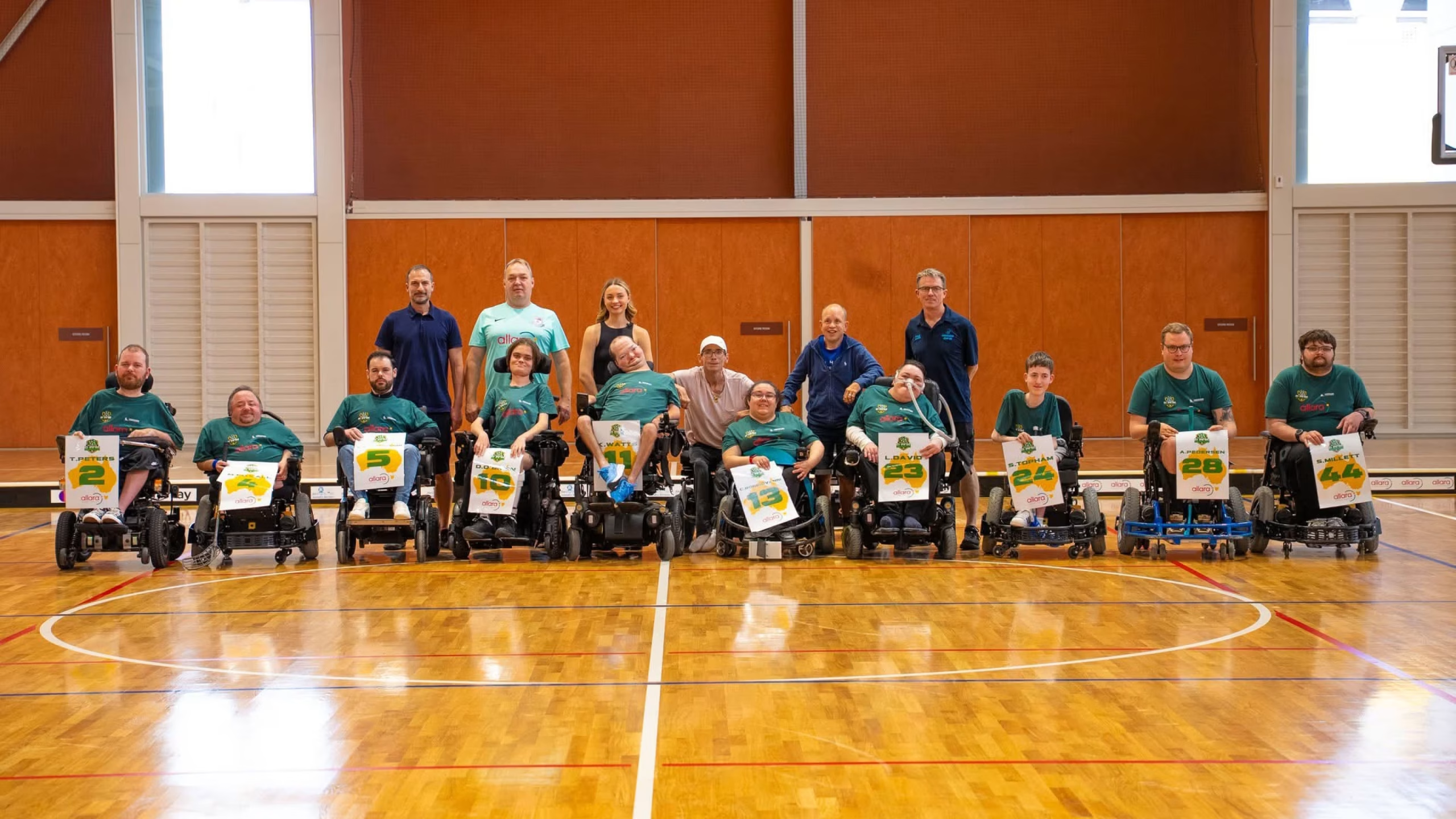
That same sporting spirit has long fuelled Australia’s commitment to Powerchair Hockey. Despite the geographic isolation and demanding travel required for every major event, the nation has remained a regular presence on the world stage. Known as The Australian Sliders, the team once again arrives with ambition and a growing sense of momentum.
History, Pride and a Famous Night in Helsinki
Australia has taken part in multiple World Championships and has helped broaden the global reach of the sport. While several tournaments ended in the lower classification places, one campaign remains unforgettable.
At the first official World Championship in Helsinki in 2004, Australia produced the greatest result in its history. In a dramatic group stage encounter against host nation Finland, the Australians edged a thrilling 5 to 4 victory in one of the classic matches of that era. The win secured the nation’s first and so far only semi final appearance. Australia would go on to finish an outstanding fourth overall.
More than two decades later, returning to Finland offers a symbolic opportunity to reconnect with that landmark achievement.
Dutch Legends Guiding a New Era
When discussing Australian Powerchair Hockey, two names immediately command respect: Berrie Hommel and Marcel van den Muysenberg.
Both are widely regarded as cross-generational legends of the sport. Van den Muysenberg earned admiration for his intelligence, movement and ability to create openings in the tightest spaces. Hommel became one of the most ruthless finishers the game has seen, scoring 104 international goals and remaining among the all-time leading scorers.
Now working together as Australia’s coaching duo, they bring elite level experience, including multiple European and World Championship triumphs during their careers. They also played a significant role in Denmark’s development as a major international force during the cycle that culminated in the country’s world title success in 2022.
Their arrival has naturally raised expectations around the Australian program.
Veterans Return and Reinforcements Arrive
One of the most important figures on court could be Michael Foxall. A key player during the historic 2004 run and the leading scorer in Australian history with 20 international goals, Foxall has returned from a long retirement in time for the 2026 World Championship. His experience, leadership and uplifting presence could be invaluable in pressure moments.
Alongside him is hand stick player Luke David. At the 2018 World Championship in Italy, David stood out with his composed build up play and tireless work rate, scoring six goals despite Australia finishing last. The same result followed in 2022 in Switzerland, but the current squad believes this tournament can be different.
The most eye catching addition is Alexander Pedersen. The world champion playmaker from Denmark was an influential performer during that nation’s remarkable title winning campaign and regularly troubled elite defences with his creativity and control. Pedersen was the first applicant of the new rules allowing a nationality change he now joins the Australian national team and gives the Sliders a player capable of changing matches.
Tactical Mystery and New Possibilities
Australia may be one of the most difficult teams in the tournament to predict tactically. Unlike many European sides who meet regularly in regional competition, the Australians operate at a greater distance from the sport’s main competitive hubs. That often makes their development less visible to opponents.
With Dutch coaches on the bench and Pedersen available as a natural organiser, it would be no surprise to see Australia build around a central playmaking structure while maintaining disciplined defensive shape. At the same time, the team now appears to have greater flexibility and more attacking options than in recent years.
That uncertainty itself could become a weapon.
A Brutal Opening Schedule
The fixture list offers no gentle introduction. Australia begins against Germany, one of the title contenders and current European runners-up. Later the same day comes a meeting with reigning European champions and tournament favourites Netherlands.
The remaining group matches against Belgium and Canada round up the race for the semi finals.
Outlook
The Australian Sliders are expected to be more competitive than at the last two World Championships, but the reality is that this will be a demanding test from the very start. The opening games against Germany and the Netherlands will already show how far this group can realistically go in such a high-level field.
A lot hinges on how quickly Pedersen adapts to a new system and how well the experienced core can absorb the ideas of the coaching staff under true tournament pressure. There is clear upside in the roster, but it will not come easy at this level. If everything aligns at the right moments, Australia has the tools to trouble strong opponents and potentially create one or two surprises, even if a deep run remains a difficult challenge.

