

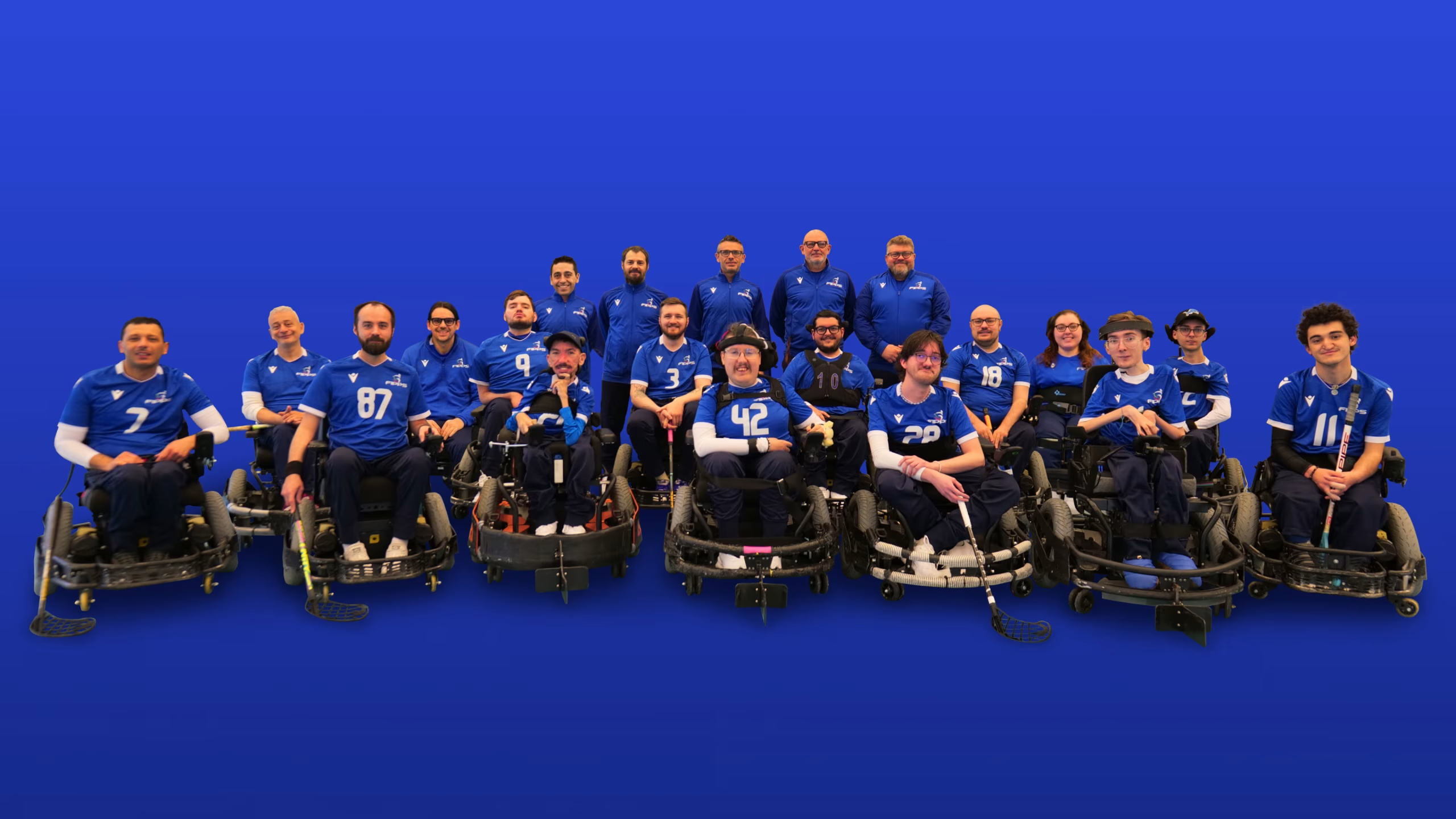
As we approach the next World Championship, IPCH is launching a special collaboration to present all participating teams. For this project, we are proud to work with Paul Emmering, former German handstick player and scorer of Germany’s historic 2010 World Championship golden goal. With his long-standing experience in Powerchair Hockey, Paul will provide analyses, insights, and expert perspectives throughout our road to the World Championship. In this article, you can read more about Italy’s insights.
A Country Defined by Culture, Craft and Global Influence
With around 60 million inhabitants, Italy stands among the larger nations both in Europe and at this World Championship. Stretching across the Mediterranean, the country blends ancient history with modern dynamism in a way few others can match.
Few places in the world offer a comparable cultural density. The Colosseum in Rome remains one of the most iconic landmarks of the ancient world, while cities like Milan represent Italy’s contemporary face as a global hub for fashion, business and design. At the same time, Florence stands as a cradle of Renaissance art and architecture, symbolizing Italy’s enduring influence on European culture.
Italian identity is also inseparable from its cuisine. Pizza, pasta, tiramisu and espresso are not simply exports but part of a deeply rooted everyday tradition. That same sense of identity, precision and pride translates naturally into sport.
A Tradition of Excellence in Powerchair Hockey
Italy’s national team, the Squadra Azzurra, arrives in Finland with a strong legacy in Powerchair Hockey. The country has been a consistent presence at major tournaments and has also established itself as one of the sport’s most trusted hosts.
Italy organized the World Championships in 2010 and 2018 in Lignano Sabbiadoro and hosted the 2005 European Championship in Rome. Each event reinforced the country’s reputation for combining professional organization with a distinct atmosphere.
On a broader stage, Italy recently underlined its global organizational strength as host of the Milano-Cortina 2026 Winter Olympics and Paralympics
The Players Who Built Italy’s Reputation
Italy’s rise in Powerchair Hockey has been shaped by influential individuals who combined leadership with performance. Claudio Carelli was one of the defining figures of an earlier generation. As a captain, playmaker and scorer, he led the team both on and off the court and finished his international career with 32 goals.
Alongside him, Tiziano Fattore became Italy’s most prolific scorer with 56 international goals. His creativity and efficiency played a central role in establishing Italy among Europe’s elite.
Italy’s greatest success came at the 2018 World Championship on home soil in Lignano Sabbiadoro. What set that tournament apart was the absence of a single dominant star. Instead, Italy relied on collective responsibility, tactical discipline and exceptional team spirit. Different players stepped up in decisive moments, making the team unpredictable and difficult to contain. Two dramatic penalty shootout victories defined the campaign, first against Germany in the semi final and then against Denmark in the final. Those performances secured Italy’s first world title and remain a defining chapter in the sport’s history.
Depth, Experience and Emerging Quality
Italy’s current squad once again combines experience with new potential. Head Coach Massimo della Torre has a wide range of options to choose from.
In goal, Roberto Graziano and Simone Ranzato provide two reliable T-Stick options, allowing tactical flexibility depending on match situations.
As a handstick Ion Jignea remains a central figure on the court. Having already contributed to the 2018 title, he brings experience, defensive intelligence and the ability to influence the game in key moments.
Among the emerging players, Leonardo Catania stands out. His powerful attacking style and direct approach make him a constant threat. With 26 international goals, his trajectory suggests further growth at the highest level.
Tactical Clarity and Competitive Balance
Italy has built its identity around defensive organization. Rather than relying on strict one on one marking, the team emphasizes coordinated positioning, rotation and collective awareness, making it difficult for opponents to create clear scoring opportunities. At the same time, Italy is highly effective going forward. By controlling tempo and dictating rhythm, the team often forces opponents into uncomfortable situations, creating advantages through structure rather than chaos.
This balance between defensive discipline and offensive precision remains one of Italy’s defining strengths.
Italy opens its campaign against Spain before facing a critical sequence of matches. A key encounter with Switzerland could shape the battle for group positioning, followed by a decisive clash against reigning world champions Denmark. The group stage concludes against host nation Finland, a matchup that may carry significant implications depending on earlier results.
Outlook
Italy enters the tournament as a legitimate contender for a semi final place. Recent performances, including a highly competitive match against Netherlands at the Dutch Cup 2025, underline the team’s potential.
If Italy’s defensive structure performs at its usual high level and the offense delivers at key moments, a place in the final is within reach. At this stage of the competition, however, margins are minimal and decisive moments often define the outcome.

